
The Sisi Museum in Vienna offers an intimate look at one of history’s most fascinating empresses, moving beyond the romantic myth to reveal the complex, often tragic woman behind the crown.
Support when you need it
Customer service to help you with all your needs from 8:00 a.m. to 7:00 p.m.
Fast and online booking
Choose the best option for your needs and preferences and avoid the lines.
Top attraction in Vienna
Experience the grandeur of Austria’s imperial history in the heart of the city, a must-see for every visitor.
Here’s where things get a bit confusing for first-time visitors. The Hofburg Palace is a massive imperial complex with 18 wings, 19 courtyards, and over 2,600 rooms, housing multiple museums, government offices, and cultural institutions. The Sisi Museum is just one specific part of this sprawling palace.
So, while they aren’t exactly “the same,” you cannot visit the museum without entering the palace. The great news is that your ticket to the Hofburg automatically grants you access to the Sisi Museum and the Imperial Apartments. You don’t have to worry about buying separate entries for these connected areas, which makes things much easier.
This matters because you might see other entrances around the Hofburg complex leading to completely different museums, like the Imperial Treasury or the Spanish Riding School. Those require separate tickets.
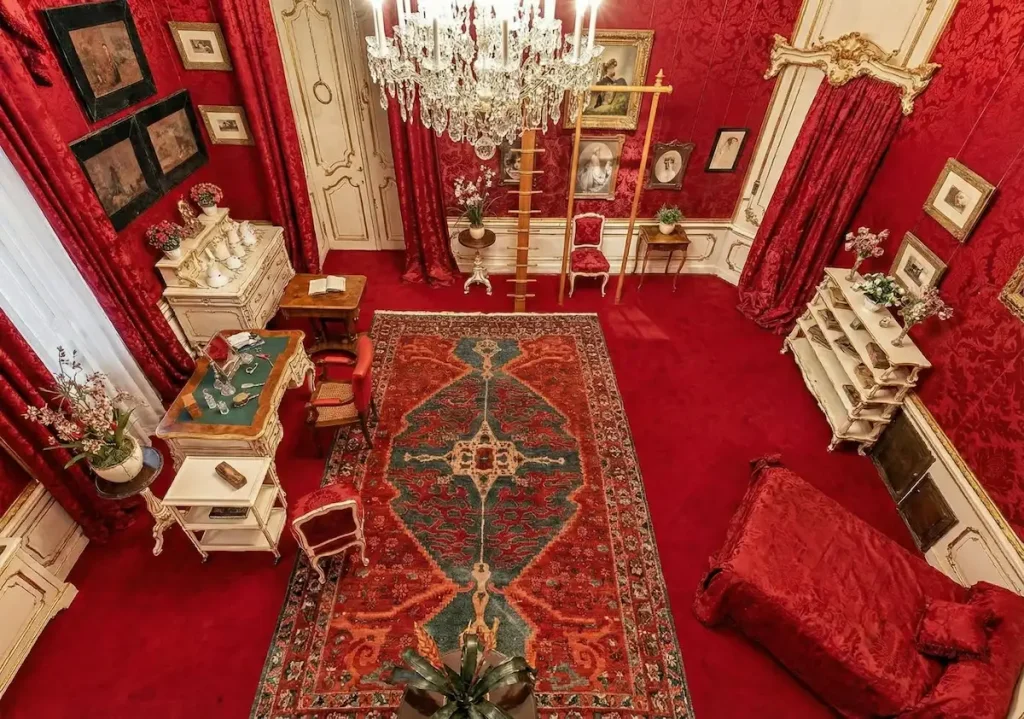
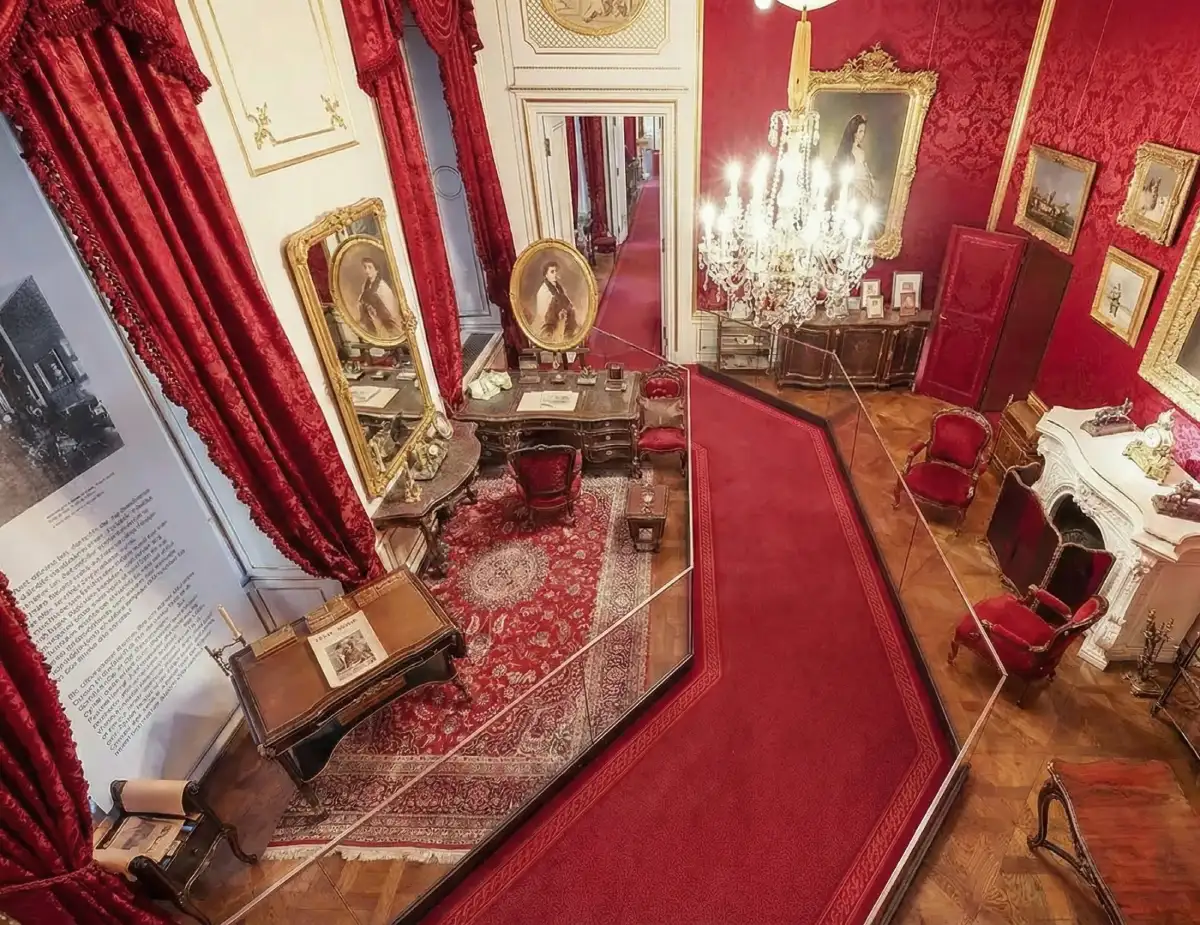
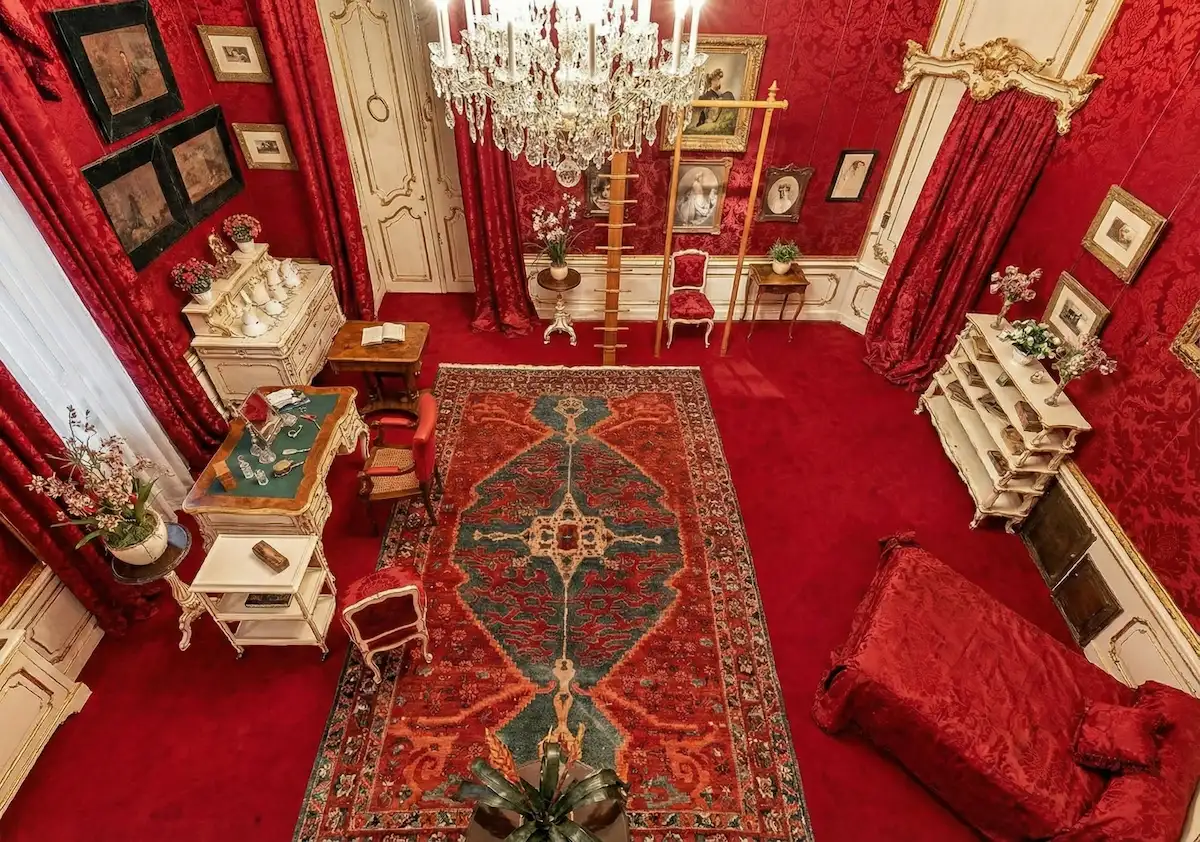
This isn’t your typical museum filled with dusty, impersonal artifacts. Instead, the museum focuses on something far more powerful: objects that Elisabeth actually touched and used every day.
You can see her famous watercolor box, her 63-piece travel medical kit (more on that later!), and the reconstruction of her luxurious railway carriage. It includes her breathtaking mourning dresses and the jewelry she wore after the tragedy of her son. These aren’t just “things,” they are windows into a life that was far more difficult than the fairy tales suggest.
It is an absolute must-see if you want to understand the human being behind the crown.
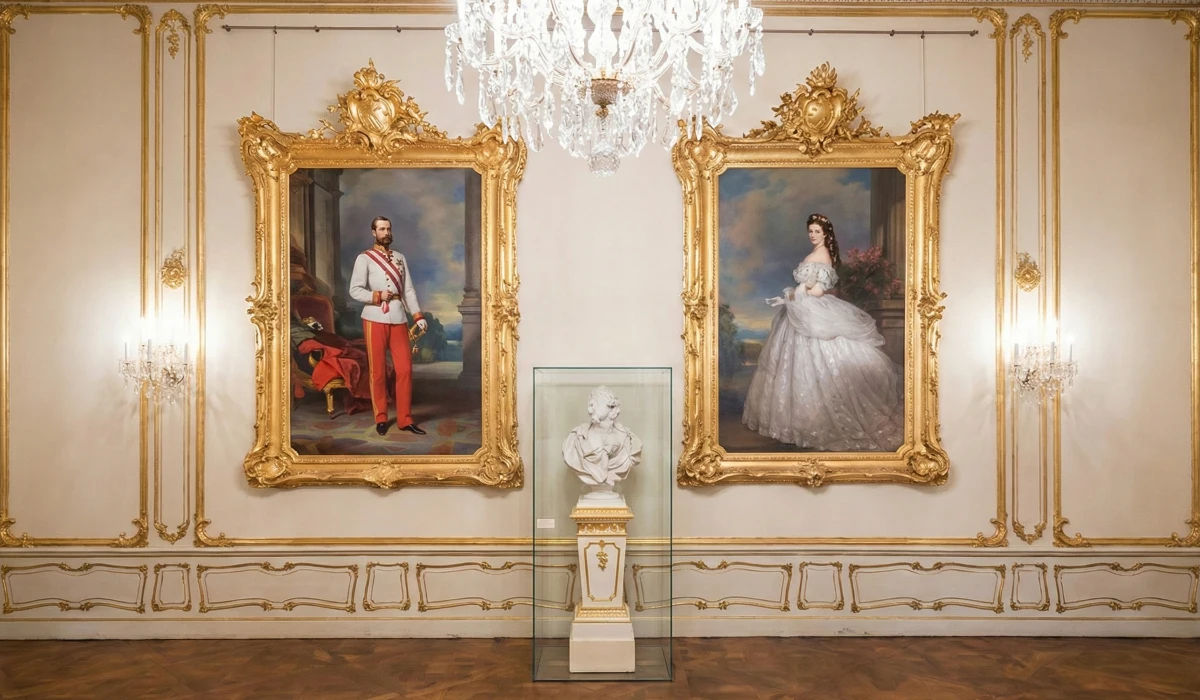
It’s designed to make you uncomfortable. The first room shows you Elisabeth’s death mask and a replica of the sharpened file that killed her. The lighting is muted, almost somber. The scenography uses dark colors and intimate spaces rather than grand halls.
You won’t find much about military victories, territorial expansion, or diplomatic triumphs here. Instead, you’ll learn about Elisabeth’s eating disorder (she consumed mostly juice and raw meat), her probable depression and anxiety, and her use of poetry to write brutal satires about her mother-in-law and the Habsburg court.
The museum displays her gym equipment, which sounds trivial until you understand that installing gymnastics rings in imperial apartments was scandalous. It shows her travel medical kit with a cocaine syringe, which reveals how she self-medicated for chronic pain and mental health struggles. It features her mourning jewelry made from jet and onyx, symbols of the permanent grief she wore after her son’s suicide.
If you’re expecting Versailles-level grandeur or vast collections of crown jewels, you might leave underwhelmed. But if you want to understand the human cost of being trapped in a life you didn’t choose, absolutely.
Be realistic with your planning. If you want to read the plaques and listen to the audio guide properly, budget 60 minutes for just the Sisi Museum section, then another 30-45 minutes for the Imperial Apartments. Total time: 90 minutes to 2 hours.
You can rush through in 40 minutes if you’re just glancing at objects and skipping most of the audio, but you’ll miss the entire point. The Sisi Museum is narrative-driven; speeding through turns it into a random collection of old dresses and furniture.
No. One ticket covers both the Sisi Museum and the Imperial Apartments. They’re part of the same ticketed route, and you visit them in sequence.
No. Put the camera away. They are very strict about this. It is forbidden to take photos or videos in the historic rooms to protect the light-sensitive textiles and to keep the crowd moving in the narrow corridors. If you try to sneak a pic, security will stop you, and it ruins the vibe. Just enjoy the moment with your eyes.
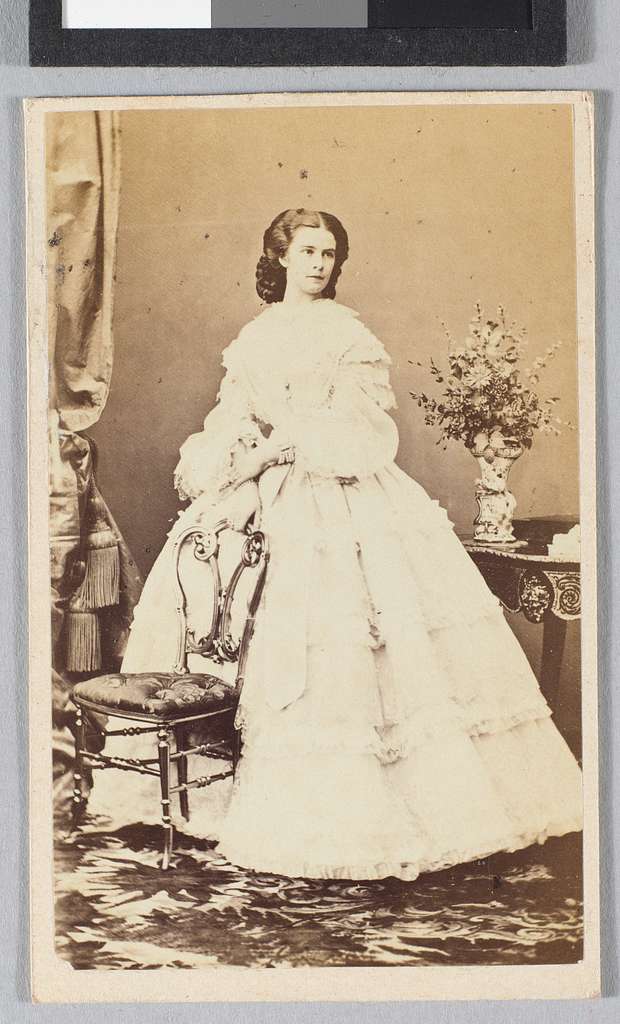
Elisabeth of Bavaria became Empress of Austria at just 16 years old when she married Emperor Franz Joseph in 1854. But here’s what makes her story resonate 170 years later: she never wanted the job.
Imagine being a free-spirited princess raised in the Bavarian countryside, riding horses and writing poetry, suddenly thrust into the suffocating formality of the Habsburg court. The “Spanish Etiquette” that governed Vienna made every meal, every conversation, every moment a performance. Elisabeth rebelled in every way she could.
She became important not because of what she did as empress, but because of what she represented.
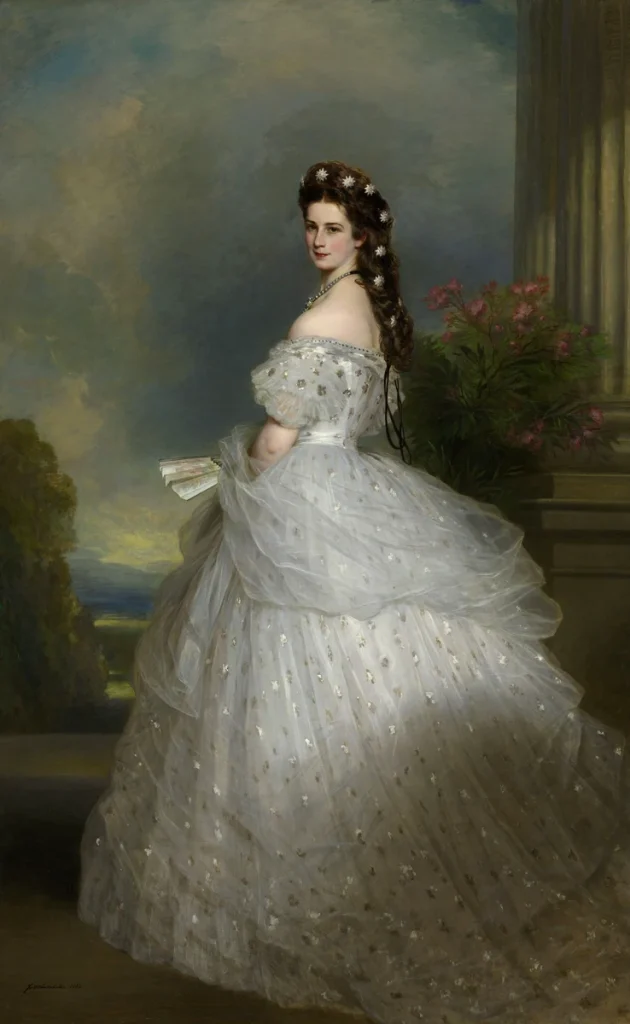
She was possibly the first modern celebrity, obsessed with maintaining her beauty through extreme diets and grueling exercise routines. She kept her waist at 50 cm and her weight rarely exceeded 50 kg despite being 1.72 m tall. Sisi traveled constantly, spending months in Hungary, Greece, and England, anywhere but Vienna.
Her influence extended beyond vanity. Elisabeth championed Hungarian autonomy, helping secure the Austro-Hungarian Compromise of 1867. She learned multiple languages fluently (including Hungarian, which endeared her to that half of the empire). Her poetry, hidden for decades, revealed a sharp political mind critical of aristocratic privilege.
But what truly cemented her legend was tragedy. Her only son, Crown Prince Rudolf, died in a murder-suicide in 1889. Elisabeth never recovered, wearing only black for the remaining nine years of her life. In 1898, an Italian anarchist stabbed her with a sharpened file while she was boarding a ship in Geneva. Sisi died at 60, having spent most of her adult life trying to escape the cage her title created.
The Hofburg complex is basically a small city, so there are other treasures scattered throughout that you can explore before or after the Sisi Museum.
Within walking distance, you’ll find:
The museum is open every day of the year, including holidays, from 9:00 to 17:30.
But here’s the catch that trips people up: last admission is at 16:30, a full hour before closing.
If you’re using GPS, search for “Michaelerplatz 1, 1010 Wien” or “Hofburg Kaiserappartements.”
Getting there:
The entrance is located under the Michaelerkuppel (St. Michael’s Dome) on Michaelerplatz. This matters because the Hofburg has multiple entrances, and showing up at the wrong one will cost you 10 minutes of confused wandering.
Once you arrive at Michaelerplatz, walk directly into the rotunda under the green dome. The ticket office and entrance are inside this courtyard, not on the street level.
You’ll pass through security (bag check), then reach the ticket desk. After purchasing or scanning your ticket, you’ll go through turnstiles. This is your point of no return, which brings us to something critical: use the bathrooms before you enter.
There are no restrooms inside the museum or the Imperial Apartments.
The audio guide isn’t just included; it’s essential. Without it, you’re looking at objects with minimal context.
How to get it: When you purchase your ticket, you’ll automatically be offered a handheld audio guide device. There’s no additional charge; it’s included in your admission price.
Language options: The audio guide is available in 14 languages, including English, Spanish, German, French, Italian, and more. Just specify your language preference when you pick up the device.
Digital alternative: If you prefer using your own device, download the “ivie” app before you arrive (it’s Vienna’s official tourist app). The app includes the Sisi Museum audio tour, which you can access with your ticket. Bring your own earbuds or headphones for this option, as the museum doesn’t provide them for the app. This is more hygienic anyway, and you’ll probably get better sound quality than the standard museum headphones.
The audio guide includes narration by historians, excerpts from Elisabeth’s poetry, and explanations of the symbolism behind specific objects. Certain items, like her cocaine syringe or her mourning jewelry, make no sense without this context.
It’s designed to make you uncomfortable. The first room shows you Elisabeth’s death mask and a replica of the sharpened file that killed her. The lighting is muted, almost somber. The scenography uses dark colors and intimate spaces rather than grand halls.
You won’t find much about military victories, territorial expansion, or diplomatic triumphs here. Instead, you’ll learn about Elisabeth’s eating disorder (she consumed mostly juice and raw meat), her probable depression and anxiety, and her use of poetry to write brutal satires about her mother-in-law and the Habsburg court.
The museum displays her gym equipment, which sounds trivial until you understand that installing gymnastics rings in imperial apartments was scandalous. It shows her travel medical kit with a cocaine syringe, which reveals how she self-medicated for chronic pain and mental health struggles. It features her mourning jewelry made from jet and onyx, symbols of the permanent grief she wore after her son’s suicide.
If you’re expecting Versailles-level grandeur or vast collections of crown jewels, you might leave underwhelmed. But if you want to understand the human cost of being trapped in a life you didn’t choose, absolutely.
Be realistic with your planning. If you want to read the plaques and listen to the audio guide properly, budget 60 minutes for just the Sisi Museum section, then another 30-45 minutes for the Imperial Apartments. Total time: 90 minutes to 2 hours.
You can rush through in 40 minutes if you’re just glancing at objects and skipping most of the audio, but you’ll miss the entire point. The Sisi Museum is narrative-driven; speeding through turns it into a random collection of old dresses and furniture.
No. One ticket covers both the Sisi Museum and the Imperial Apartments. They’re part of the same ticketed route, and you visit them in sequence.
No. Put the camera away. They are very strict about this. It is forbidden to take photos or videos in the historic rooms to protect the light-sensitive textiles and to keep the crowd moving in the narrow corridors. If you try to sneak a pic, security will stop you, and it ruins the vibe. Just enjoy the moment with your eyes.


